
Accelerations from match starts
Transcript
Train your sprint from real match starts. Here's how. Warm up first. You need a tape measure and two cones. Measure twenty metres on flat grass, never a road, with room to slow down. Watch. side-on, turn and go. Rolling, jog in and go. Face down, push up and go. First, push the ground back behind you. Not straight up. Then, rise like a plane taking off. Our target is six to eight sprints, walking back and resting one to two minutes between them. Under twelve, or under fourteen for later developers, play chase and tag games instead. Then take the free test at footballreach.com.
What it trains
Short, flat-out accelerations from the starts a match gives you: side-on, on the move and up off the ground. Full rest between them, so every rep is fresh and fast.
Set up
- Warm up first
- 2 cones: start, finish
- 20 m, tape-measured
- Room to slow down
Kit used here:
Disc cones Disc conesFlat disc cones, about 19 cm across, for gates, boxes and grids. Packs of 10, or 50 with a carry bag.Trend Checkout, our own shop - opens in a new tab, 30 m tape measure
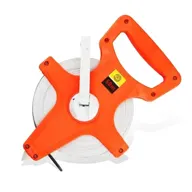 30 m tape measureOpen-reel fibreglass tape in 30, 50 or 100 m, marked in cm and inches, for measuring sprint distances.Trend Checkout, our own shop - opens in a new tab. Sold by Trend Checkout, our own online shop (run by Apps 365 Ltd, the company behind Football Reach). Any similar kit works just as well.
How it works
- Warm up first: FIFA 11+ Kids (ages 7-13), FIFA 11+ (from 14) or your club warm-up. Then 2-3 build-up runs, each a little faster.
- On flat, dry grass or a track, tape-measure 20 m. A cone on the start line and one on the finish line, with at least 10 m of clear run-off.
- Side-on: stand sideways on the start line, then turn and sprint through the finish. Rolling: jog in from about 5 m back and go flat out at the line.
- Face down: lie on your front behind the line, head towards the finish, hands under your shoulders. Push up and sprint.
- Ease down in the run-off, walk back and rest 1-2 minutes. Do 6-8 sprints, mixing the starts; stop early if you are clearly slowing.
Coaching points
- Push the ground back. Lean forward and push the ground back behind you on every step, with each foot landing under your hips, not out in front.
- Rise like a plane. Let your body rise little by little as you speed up, like a plane taking off. You are only running tall once you are near top speed.
Not this
Popping straight up in the first steps. Standing tall too soon means you push down instead of back, so the start loses its drive.
Dose
- 6-8 sprints, mixed starts
- Walk back, rest 1-2 min
Our target: 6-8 sprints of 10-20 m a session, inside the plan's 6-8 sprints (not extra), walking back and resting 1-2 minutes (our target).
Harder / Easier
Harder
Race a partner from mixed starts (one face down, one side-on), or have a partner roll a ball past you and race it to the finish cone.
Easier
Use 10 m and only the side-on and rolling starts. Under 12 (14 for later developers): chase and tag games, the plan's choice; research on the best age is mixed.
Safety
- Never sprint from cold. Under 18: an adult or coach nearby.
- Flat, dry grass or a track, never a road, pavement or driveway. Keep the run-off clear of walls, fences, posts and people. Face down: clean, dry grass.
- Under 16: knee or heel pain when you run or jump? Stop and tell an adult. Growth pains are common; a GP or physio can help.
- Chest pain, faint or dizzy: stop at once (under 16: tell an adult); GP or NHS 111 the same day, 999 if someone collapses.
- Tight hamstring or any pain: stop, see a GP or physio; never train through it.
Sources
- NSCA - The need for speed (starts, lean, rest) (opens in a new tab)
- England Football - movement skills (opens in a new tab)
- PubMed - Moran et al. 2017, youth sprint meta-analysis (opens in a new tab)
- PubMed - Moran et al. 2018, sprints by maturity (opens in a new tab)
- PubMed - Rossler et al. 2018, FIFA 11+ Kids (opens in a new tab)
- FIFA - the FIFA 11+ (opens in a new tab)
Not sure which skill to work on first? The free Football Reach test gives you a Player Development Score and shows which of the four corners of your game to work on next, in about two minutes.
Take the free test

